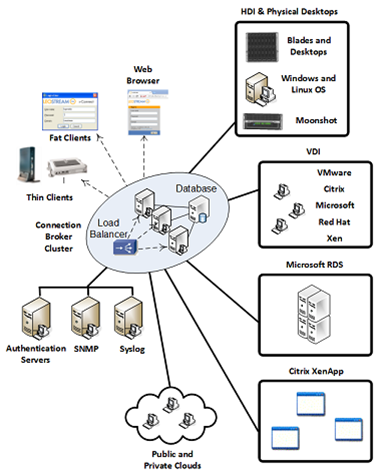
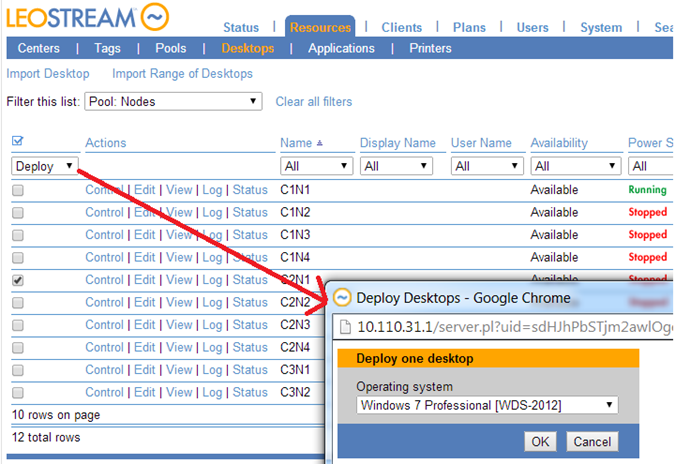
Web Client: A separate Leostream Web client allows users to access their desktops and applications via the Web, and simultaneous access to the Connection Broker Administrator Web interface, as dictated by user’s role and permissions.
Roles and Permissions:
End user functionality:Roles and policies now work together to provide fine granular control over end user actions including restarting and releasing desktops or managing another users’ sessions.
Administrative functionality:Expanded permissions levels can match the “separation of tasks” to user roles by providing or limiting administrator access to individual pieces of the Connection Broker Administrator Web interface.
Increased Platform Flexibility: Support for the Xen.org centers adds to Leostream’s existing range of support for the leading virtualization platforms. A Leostream Java Agent installs on the Xen hypervisor to provide inventory and power control for Xen virtual machines. This integration provides enterprises with a wider range of platform choice and enables efficient and effective management of HVDs built on the Xen open source hypervisor platform.
Enhanced Remote Access Support for Sun Environments: Tight integration with Sun Secure Global Desktop Software builds upon the Leostream Connection Broker’s existing support for best-in-class gateways and SSL VPNs, and the Connection Broker’s long-standing support for the SunRay/SRSS/Sun ALP environment. With SSGD integration, the Connection Broker now provides secure Web access to Sun environments from any client device.
Expanded Support for Hardware PCoIP:Enables quad-monitor layouts for hardware PCoIP, as well as seamless single sign-on for PCoIP clients. Includes automatic binding for PCoIP cards in Amulet Hotkey devices and “follow-me” mode for all PCoIP clients.
Optimized End-user Experience:
Protocol plans: make the hosted virtual desktop infrastructure “protocol-aware.” System administrators can maintain granular control of remote viewing sessions in multiple protocol environments by specifying exactly which protocols to try and in which order. The protocol plans also allow an available protocol to be skipped. If, for example, all the virtual machines in a VDI have RGS senders installed and there is a group of task workers (i.e. non-power users) connecting, protocol plans can be set up to ensure these users never connect using RGS. For another group, consisting of power users, a second protocol plan could be configured to use RGS.
Registry plans: allow for the setting of registry keys on remote desktops based on the client device the user logs in from, providing location-based tuning of the end user’s experience.
Dynamic CD and DVD drive redirection: ensures that CD and DVD drives are redirected correctly regardless of the drive letter or client in RDP. Dynamic tags allow IT to specify which, if any, drives to redirect to a user’s remote desktop, further locking down the user’s environment.
Ericom Blaze RDP Acceleration and Compression: Support for Ericom Blaze adds another high-performance protocol to Leostream’s extensive portfolio of supported clients and protocols. Leostream users can now choose the Blaze technology as one option to overcome RDP performance issues and accelerate the delivery of end user computing resources.
Easy installation as a virtual appliance: A new Leostream Connection Broker virtual appliance provides native installation on a Windows Server 2008 R2 Hyper-V or Microsoft Hyper-V Server 2008 R2 hypervisor; and
Native support for Hyper-V based virtual machines: Simplified discovery and machine power control.
End-user Experience Pack: The Connection Broker provides a complete set of features to create an optimal end-user experience with Microsoft desktop virtualization software
Windows 7 support: support for Microsoft’s new Windows 7 operating system;
RDP 7 support: full support for the new remote desktop protocol (RDP) 7, with its high-performance enhancements such as bi-directional audio and rich graphics;
Multimonitor support: Leostream supports multiple monitors with RDP and a wide range of additional protocols;
USB Management: USB passthrough policies allow administrators to manage classes of devices or individual devices, depending on need. USB policies can be combined with other Leostream policies, such as location-based policies, to support the exact implementation of business rules;
Location-based printing: Administrators can specify a list of network printers to connect to a particular group of clients based on their location. End-users can select local printers when connected to remote desktops;
Single Sign On for RDP: Provides seamless access to all versions of Windows virtual desktops from any client device, including Windows 2000, 2003, Windows XP, Windows Vista, and Windows 7;
User profile support: Consistently offers the same desktop to the user who travels or changes physical location; and
Extensive flexibility in assigning users to resources such as desktops, applications and sessions: Leostream’s powerful policy capabilities are natively available in Microsoft environments.